Chapter Overview
This chapter focuses on techniques for evaluating integrals and sums.
Integrals and sums appear everywhere in probability. The chance of a union is a sum. Chances that continuous random variables fall into an interval are expressed as integrals against the density. Cumulative distribution functions and survival functions are related to mass functions and density functions by sums and integrals. Expectations are weighted averages, so, like all averages, are defined by a sum or integral. Summary measures like variance and standard deviation are defined as expectations, so also demand summation or integration.
So far our toolkit for evaluating sums and integrals has been limited. Section 6.1 and Section 7.1 introduced some special series (sums of infinitely many terms) that we can evaluate (e.g. the geometric series and Taylor expansions of smooth functions), however those tools are limited to particular series. In every other case we’ve either integrated by recognizing a derivatives (e.g. is the derivative of ), or have restricted our attention to finite sums and added the terms by hand. The former is too restricted to simple functions, while the latter is too laborious.
So, we will spend this chapter developing tools for evaluating integrals (and some example sums) which will help us address more general examples.
Section 7.1 will introduce techniques for evaluating integrals and sums of:
linear combinations of functions, and
products of functions. To evaluate the integral of a product we will introduce integration by parts.
Section 7.2 will introduce techniques for evaluating integrals of compositions of functions.
We will focus on substitution and will show that the substitution rule recovers the generic rule for
change of density under a transformation of a random variable.
The two special rules covered in this chapter (integration by parts and integration by substitution) are the two most important and widely applicable. They are analogous to the product and chain rules of differentiation. Unlike differentiation, there are many more specialized techniques for computing integrals. Here’s a flowchart from XKCD comparing procedures for differentiation to integration.
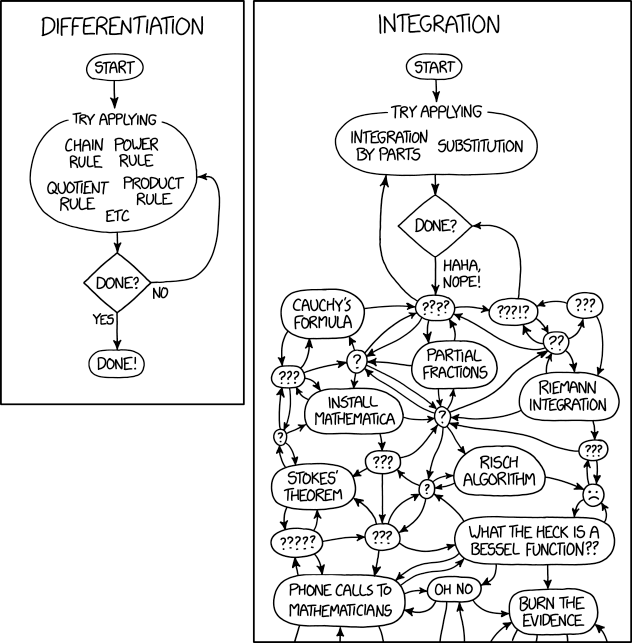
This chapter focuses on the top box. If you’d like to learn more about the messy web of special integration techniques, look for resources from an integral calculus course.